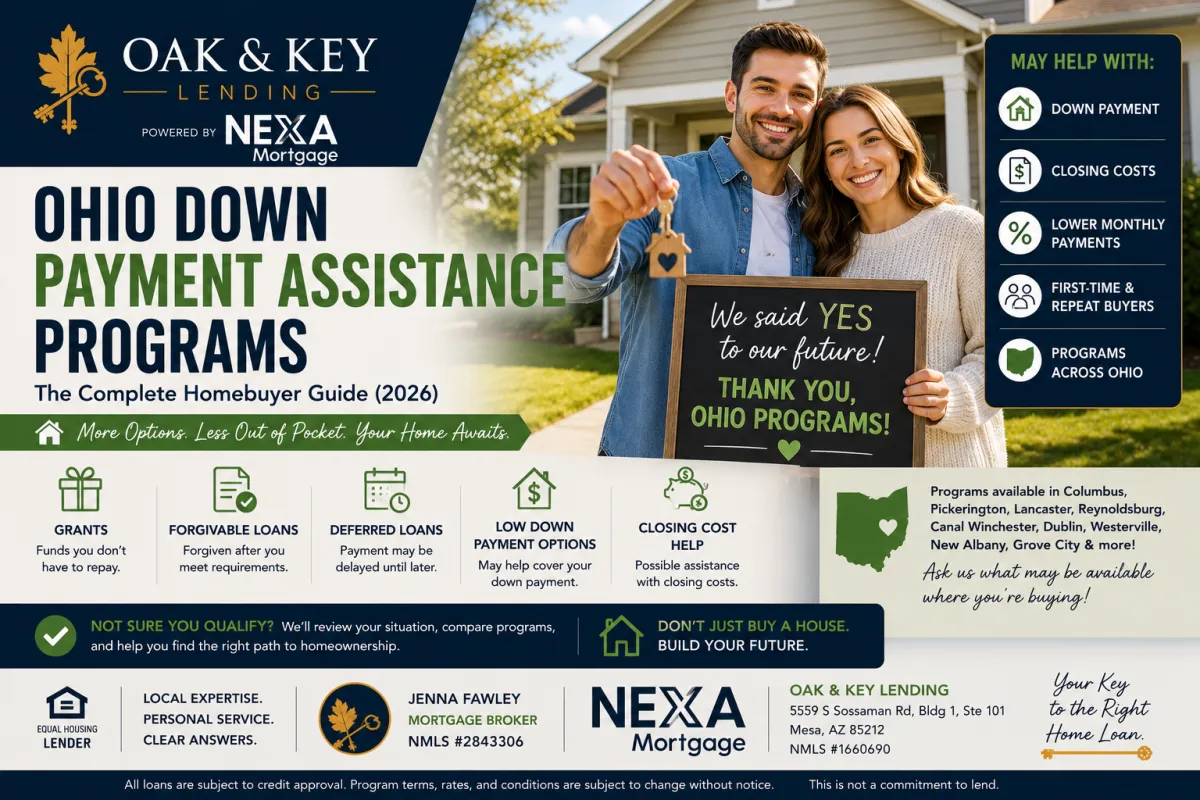
Ohio Down Payment Assistance Guide 2026
Mortgages, Ohio down payment assistance, First-time home buyer programs Ohio
Ohio Down Payment Assistance Programs: The Complete Homebuyer Guide (2026)
Explore Ohio down payment assistance programs, including grants, forgivable loans, eligibility rules, and options for first-time and repeat buyers across Columbus, Franklin County, Fairfield County, and beyond.
You May Not Need as Much Cash as You Think
Many Ohio buyers quietly repeat the same belief: “I can’t buy a house because I don’t have enough saved for the down payment.” In reality, Ohio offers a wide range of down payment assistance (DPA) programs that can help with the upfront costs of buying a home — especially for first-time buyers, recent graduates, and qualifying service professionals. These programs can be powerful tools, but they are not all “free money.”
Depending on the program, your assistance might come as a grant, a forgivable second mortgage, a deferred-payment loan, a repayable second mortgage, or a reduced-rate mortgage paired with other benefits. The goal of this guide is to help you understand how Ohio down payment assistance works, who may qualify, and how to decide whether using assistance makes sense for your situation.
What Is Down Payment Assistance?
Down payment assistance is any program that helps eligible buyers cover some of the upfront costs of purchasing a home. In Ohio, these programs are often offered through the Ohio Housing Finance Agency (OHFA), local governments, or community development organizations. The money is usually designed to help with:
The down payment itself (your contribution toward the purchase price)
Closing costs (lender fees, title costs, recording fees, and more)
Prepaid expenses (property taxes, homeowners insurance, prepaid interest, and escrow setup)
Other eligible home-purchase costs, depending on the specific program rules
Each program sets its own rules about how funds can be used, how much assistance is available, and what happens if you sell, refinance, or move out of the home. That’s why it’s important to understand the structure behind the help you’re receiving.
Is Down Payment Assistance Free Money?
Some Ohio home buying grants truly function like free money when you meet all the requirements. Others are more like a second loan that sits behind your main mortgage. Here are the common structures you’ll see in Ohio down payment assistance programs:
Grants
A grant is assistance that typically does not need to be repaid as long as you follow the program rules. Some local Ohio home buyer programs offer true grants, often with requirements tied to income, property location, or how long you live in the home. Funds are usually limited and may be available on a first-come, first-served basis.
Forgivable Loans
A forgivable loan is technically a second mortgage, but the balance can be forgiven over time. For example, OHFA’s statewide down payment assistance is structured as a forgivable second mortgage over seven years for reservations made since July 1, 2025, and continuing in 2026. If you sell or refinance before that forgiveness period is over, you may need to repay the remaining balance. (Source: myohiohome.org)
Deferred-Payment Loans
A deferred-payment loan is a second mortgage where you don’t make monthly payments right away. Instead, the balance becomes due when a specific event occurs, such as selling the home, refinancing, or paying off the first mortgage. Some city and county programs in Ohio use this structure, often with low or zero interest.
Repayable Second Mortgages
A repayable second mortgage is a separate loan with its own monthly payment and terms. It can still be valuable if it lets you buy sooner or preserve cash, but it directly affects your monthly budget and long-term cost of homeownership.
📌 Key Takeaway: Always ask your lender exactly what happens to your down payment assistance if you sell, move out, or refinance. The answer can significantly affect your future flexibility.
Do You Have to Be a First-Time Homebuyer?
Many people search for first-time home buyer programs Ohio and assume that if they’ve ever owned a home, they’re automatically disqualified. That’s not always true. First, many programs define a “first-time homebuyer” as someone who has not owned a principal residence in the last three years. If you sold a home several years ago and have been renting since, you might still count as a first-time buyer under that definition.
Second, Ohio also offers options specifically for repeat buyers. OHFA’s Next Home Program is designed for people who have owned a home in the past three years and are now purchasing a different property, allowing them to access many of the same benefits first-time buyers receive. (Source: ohiohome.org)
Who Qualifies for Down Payment Assistance in Ohio?
Eligibility for Ohio down payment assistance varies widely by program, but most look at a similar set of factors:
Household income: Many programs have maximum income limits that depend on county, household size, and program type.
Credit and debt-to-income ratio (DTI): You must qualify for the underlying mortgage and sometimes meet additional program standards.
Purchase price: OHFA and many local programs cap the maximum purchase price, which can vary by county and property type.
Property location: Some assistance is statewide, while others apply only in certain cities, neighborhoods, or census tracts.
Occupancy: Most programs require the home to be your primary residence, not a rental or vacation property.
Homebuyer education: OHFA and many local programs require a HUD-approved homebuyer education course before closing. (Source: ohiohome.org)
Mortgage program: Some assistance is only available with certain loan types (FHA, conventional, VA, USDA) or through approved lenders.
Because each program is different, the best way to know what you qualify for is to talk with a lender familiar with Ohio home buyer programs and have them review your full financial picture.
Ohio Housing Finance Agency (OHFA) Programs
The Ohio Housing Finance Agency (OHFA) is the primary statewide source of down payment assistance Ohio buyers use. OHFA doesn’t lend directly to consumers; instead, it works with participating lenders to offer:
Affordable fixed-rate mortgages for eligible buyers
Down payment assistance as a forgivable second mortgage
Special programs for recent graduates and public service professionals
Mortgage Tax Credits that reduce your federal income tax bill
Program names, income and purchase price limits, and assistance percentages can change over time. As of 2026, OHFA’s core offerings include:
OHFA Down Payment Assistance (DPA): 3% of the purchase price for conventional loans and 3.5% for FHA, VA, or USDA loans, structured as a seven-year forgivable second mortgage. (Source: myohiohome.org)
Grants for Grads: Down payment assistance plus a discounted interest rate for recent college graduates, with forgiveness over five years.
Ohio Heroes: Discounted interest rates for qualifying veterans, military members, first responders, medical professionals, and educators.
Mortgage Tax Credit (MTC): A federal tax credit on a portion of your mortgage interest, with MTC Plus offering up to a 40% credit (capped at $2,000 per year) when paired with OHFA loans.
Next Home: A program that opens benefits to repeat buyers who currently own or have recently owned a home.
Statewide OHFA programs form the backbone of Ohio home buyer assistance.
OHFA Your Choice! Down Payment Assistance (2026 Program Information — Verify Current Availability)
📌 2026 Program Information — Verify Current Availability: OHFA program details, including assistance percentages and forgiveness rules, can change. Always confirm the latest guidelines with an OHFA-approved lender or at myohiohome.org before making decisions.
OHFA’s primary down payment assistance is sometimes referred to as a “Your Choice” program because you can typically choose between different assistance options paired with fixed-rate mortgages. As of 2026, OHFA DPA:
Provides 3% of the purchase price on conventional loans and 3.5% on FHA, VA, or USDA loans.
Can be applied toward down payment, closing costs, or prepaid expenses.
Is structured as a forgivable second mortgage over seven years; sell or refinance before that and you may owe some or all of the assistance back.
Requires the home to be a primary residence and the borrower to meet OHFA income and purchase price limits.
This assistance can be combined with different loan types, but only through participating lenders. Your lender will confirm whether your chosen mortgage program is compatible and walk you through the long-term implications of the second mortgage.
Ohio Grants vs. Down Payment Assistance
When buyers search for Ohio first-time buyer grants or home buying grants Ohio, they’re often using “grant” as a catch-all term for any kind of assistance. In reality, what’s advertised as a “grant” might actually be a:
True grant with no repayment if rules are followed
Forgivable loan that becomes a grant over time
Deferred-payment loan due when you sell or refinance
Repayable second mortgage with its own payment
That’s why it’s essential to look past the marketing and ask: Is this money ever due back, and under what conditions? A knowledgeable lender can translate the fine print into plain language so you know exactly what you’re signing up for.
Down Payment Assistance With a Conventional Loan
Many Ohio home buyer programs can be paired with qualifying conventional mortgages. With OHFA DPA, for example, eligible buyers may receive 3% of the purchase price toward their upfront costs when using a conventional loan. Some local grant programs in Columbus, Franklin County, or Fairfield County may also allow conventional financing, subject to their own rules.
When you compare a conventional loan with and without assistance, consider:
Your monthly payment (principal, interest, taxes, insurance, and PMI)
Private mortgage insurance (PMI) cost and how long you’ll pay it
The interest rate with and without DPA or special programs
The long-term cost if a second mortgage is involved
For a deeper look at how conventional loans work in our state, see our in-depth Conventional Loans in Ohio guide, where we break down credit score guidelines, PMI, and strategy comparisons in more detail.
Down Payment Assistance With an FHA Loan
Pairing FHA financing with down payment assistance is one of the most popular combinations for first-time buyers. FHA loans allow a minimum 3.5% down payment and have flexible credit guidelines. When you add OHFA’s 3.5% assistance for government loans or a local grant, you may be able to cover all or most of your required down payment and part of your closing costs.
Keep in mind that FHA loans include upfront and monthly mortgage insurance, which affects your total monthly payment and long-term cost. Your lender can help you compare FHA + DPA versus conventional + DPA to see which structure fits your goals. For more details on FHA specifically, visit our FHA Loans in Ohio guide.
Down Payment Assistance With a VA Loan
Eligible veterans, active-duty service members, and some surviving spouses may already qualify for zero-down VA financing. That doesn’t mean down payment assistance is irrelevant. In some cases, DPA can help cover:
Allowable closing costs
Prepaid taxes and insurance
Other eligible fees, depending on the program
Because VA has its own rules about fees and credits, not every assistance program will be compatible. OHFA’s DPA and Ohio Heroes program may pair especially well for qualifying veterans and military members. To learn more about your VA options, see our dedicated VA Loans in Ohio guide.
Down Payment Assistance With USDA Loans
USDA Rural Development loans can offer zero-down financing in eligible rural and suburban areas of Ohio, including parts of Fairfield County and surrounding communities. Even with no down payment required, buyers still need to cover closing costs and prepaid expenses. That’s where compatible down payment assistance or local grants can help reduce your cash to close.
USDA loans have geographic and income limits, so they won’t fit every buyer or every property. Our USDA Loans in Ohio guide explains where these loans are available and how they can work alongside other Ohio home buyer assistance options.
Down Payment Assistance in Columbus, Ohio
If you’re searching for Columbus down payment assistance or Columbus first-time home buyer programs, you may have access to multiple layers of help:
State programs like OHFA DPA, Grants for Grads, and Ohio Heroes, available through participating lenders across Central Ohio.
County-level assistance through Franklin County or neighboring counties, sometimes targeted to specific income ranges or neighborhoods.
City or neighborhood programs administered by housing or community development organizations, which may offer grants or low-interest loans for buyers within city limits.
Availability changes frequently, and some local programs open and close based on funding. Columbus-area buyers should check both statewide OHFA options and local city/county resources when planning a purchase.
Franklin County Homebuyer Assistance
Buyers purchasing in Franklin County often ask about Franklin County home buyer assistance. In many cases, you may be able to layer:
An OHFA mortgage with down payment assistance
Any active Franklin County or City of Columbus programs (when available)
Because local offerings and income limits can change, Franklin County buyers should review the latest information from county housing departments and speak with a lender who regularly works with Central Ohio first-time home buyer programs.
Fairfield County Homebuyer Assistance
For buyers in Fairfield County — including Pickerington, Lancaster, Canal Winchester-area properties, Baltimore, Carroll, and Lithopolis — assistance can come from a mix of:
Statewide OHFA programs available anywhere in Ohio
County or municipal initiatives that may target specific cities or unincorporated areas
Since some USDA-eligible areas overlap Fairfield County, buyers here may also have access to zero-down USDA loans plus compatible assistance for closing costs, depending on the property’s exact location and program rules.
Down Payment Assistance in Pickerington
If you’re a Pickerington first-time home buyer, you’re in a unique spot that touches both Franklin and Fairfield Counties, depending on the property. That means your options may include:
OHFA statewide programs through a participating lender such as Oak & Key Lending
Any active Franklin or Fairfield County programs applicable to your address
Because Pickerington straddles county lines, program eligibility often comes down to the exact property location. A local lender who knows the area can help you identify which options apply to the home you’re considering.
Income Limits Explained
A common assumption is, “I make too much money to qualify for assistance.” Sometimes that’s true, but many buyers are surprised by how high some income limits are, especially in higher-cost counties or larger households. Programs may look at:
Borrower income only (just the people on the loan)
Total household income (everyone living in the home, even if they’re not on the mortgage)
Qualifying income vs. program eligibility income (the income used to approve your loan isn’t always the same as what’s used to test program eligibility)
Income caps also vary by county, household size, and program type. Before you assume you’re over the limit, have a lender run your numbers through the latest guidelines for the programs you’re considering.
Purchase Price Limits
Many Ohio home buyer assistance programs cap the maximum purchase price of homes they can be used with. These limits can depend on:
The county where the property is located
Whether the area is designated as a “target” or “non-target” area
The property type (single-family home, condo, duplex, etc.)
Purchase price limits are updated periodically, so it’s important to rely on current numbers rather than last year’s guidelines or online estimates that may be outdated.
Credit Requirements
Every mortgage program has its own credit standards, and down payment assistance can add another layer. It’s possible to:
Qualify for the mortgage but not for a particular assistance program, or
Qualify for one type of assistance but not another
If your credit is borderline, your lender can help you decide whether it makes more sense to:
Move forward with a loan you qualify for now, with or without assistance, or
Take a few months to improve your credit and open up more options
Homebuyer Education Requirements
Most OHFA programs and many local grants require a homebuyer education course, usually through a HUD-approved counseling agency. Far from being a hurdle, this class is often one of the most valuable parts of the process. Typical topics include:
Budgeting and preparing for homeownership costs
Understanding mortgage terms, interest, and amortization
The closing process and what to expect at the closing table
Maintaining your home and avoiding foreclosure
💡 Pro Tip: Don’t wait until the last minute to complete your class. Finishing early can make your loan process smoother and give you more time to ask questions.
Can Down Payment Assistance Pay Closing Costs?
Often, yes. Many Ohio programs allow assistance to be used toward closing costs and prepaid expenses in addition to the minimum required down payment. However, the exact rules vary by program and loan type. Some limit how much can go toward fees versus the down payment, and others may require you to contribute a certain amount of your own funds.
Can You Combine Down Payment Assistance Programs?
In some cases, you can layer assistance — for example, using an OHFA DPA loan plus a Mortgage Tax Credit, or pairing a local grant with a statewide program. In other cases, programs cannot be combined. Each has its own rules about “double-dipping.”
Your lender’s job is to:
Verify which programs are compatible with each other and your loan type
Make sure the total assistance doesn’t exceed program or investor limits
Does Down Payment Assistance Make Your Mortgage More Expensive?
Down payment assistance is incredibly helpful, but it isn’t always the cheapest long-term option. Depending on the program, you may see trade-offs such as:
A higher interest rate on your first mortgage than you’d get without assistance
A second mortgage that must be repaid or forgiven over time
Refinance restrictions or repayment triggers if you try to change your loan later
Sometimes bringing your own down payment leads to a lower rate and better long-term outcome. Other times, assistance is what makes homeownership possible sooner. The smartest approach is to run both scenarios:
Buying with assistance now vs. buying with a larger down payment later
What Happens If You Sell Your Home?
The answer depends heavily on your program. When you sell, your assistance might:
Require no repayment (true grant, or fully forgiven loan)
Require partial repayment based on how long you lived there
Require full repayment of the remaining second mortgage balance
Knowing this ahead of time helps you plan your move-up strategy and avoid surprises when it’s time to sell.
What Happens If You Refinance?
Refinancing can trigger different rules than selling. Some programs require you to repay any remaining assistance if you refinance, while others may allow certain changes after a specific period. Before you accept assistance, ask:
How long do I need to keep this loan before refinancing without penalty?
Will I owe anything if I refinance to a lower rate or different term?
Down Payment Assistance vs. Saving Longer
Buying Now With Assistance
Benefits: Enter the market sooner, start building equity, preserve more of your savings, potentially avoid rising rents or home prices.
Considerations: Program restrictions, possible higher rate, second mortgage, and future refinance or sale rules.
Waiting and Saving
Benefits: Larger down payment, fewer restrictions, potential for better loan terms and lower monthly payment.
Considerations: Uncertain future home prices and rates, ongoing rent payments, and the risk that programs or tax benefits change.
Tools like Ohio Homebuyer Plus — a tax-advantaged savings account with above-market interest — can help you grow your down payment faster if you decide to wait. (Source: tos.ohio.gov)
First-Time Homebuyer Programs in Ohio
Ohio’s first-time homebuyer landscape includes:
Conventional loans with low down payment options and PMI that can eventually be removed
FHA loans with flexible credit guidelines and 3.5% down
VA and USDA loans with potential zero-down options for eligible borrowers and properties
DPA programs layered on top of these mortgages to reduce cash to close
For a broader overview of loan types, credit, and budgeting, see our comprehensive First-Time Home Buyer Guide to Ohio, which connects directly with this down payment assistance pillar.
How Much Money Should You Have Saved?
Even with generous assistance, it’s rarely wise to arrive at closing with $0 left in the bank. In addition to your down payment and closing costs, consider funds for:
Home inspection and appraisal (often paid before closing)
Earnest money deposit when you make an offer
Moving expenses, furniture, and basic tools or lawn equipment
A starter emergency fund for repairs or unexpected bills
Your lender can help you estimate a realistic target for “cash to close” plus reserves so you feel confident, not stretched, on day one of homeownership.
How to Apply for Ohio Down Payment Assistance
Get pre-approved for a mortgage. This shows what you can afford and which loan types you qualify for. For a step-by-step walkthrough, see our Mortgage Pre-Approval Guide.
Review available assistance programs. Your lender will identify statewide OHFA options and any known local programs in Columbus, Franklin County, Fairfield County, or your target area.
Determine eligibility. Income, credit, property location, and first-time-buyer status are all reviewed against current program rules.
Compare financing with and without assistance. Run the numbers both ways so you understand the trade-offs in payment, interest rate, and long-term cost.
Complete required homebuyer education. Finish your HUD-approved class and provide the certificate to your lender and program administrator.
Find an eligible property. Work with your real estate agent to choose a home that fits both your budget and program requirements (price limits, location rules, property condition).
Complete underwriting. Your lender and the assistance program review your file, verify documents, and clear conditions.
Close on your home. Sign your loan and assistance documents, pay any remaining funds due, and receive your keys.
Common Down Payment Assistance Myths
“It’s all free money.” Not necessarily. Many programs are loans that can become grants over time or must be repaid under certain conditions.
“Only low-income buyers qualify.” Not always. Income limits can be higher than you expect, especially in certain counties or for larger households.
“You must be a first-time buyer.” Some programs are for first-time buyers only, but others (like OHFA’s Next Home) are designed for repeat buyers as well.
“You can use assistance with any mortgage.” Each program has specific loan-type and lender requirements. Compatibility must be confirmed in advance.
“You don’t need any savings.” Dangerous assumption. You’ll still need money for inspections, deposits, moving, and reserves for emergencies.
“Assistance always saves money.” Sometimes it does, sometimes it simply makes buying sooner possible. Long-term cost depends on rates, terms, and your plans.
Frequently Asked Questions About Ohio Down Payment Assistance
What down payment assistance is available in Ohio?
Statewide options include OHFA DPA, Grants for Grads, Ohio Heroes, Mortgage Tax Credits, and the Next Home program, plus local grants and loans offered by cities, counties, and nonprofits.
Does Ohio give first-time buyers money?
Ohio offers assistance that can feel like “free money” when forgiven, but most help is structured as forgivable or deferred loans with specific requirements.
What is OHFA?
The Ohio Housing Finance Agency is the statewide organization that partners with lenders to provide affordable mortgages, down payment assistance, and mortgage tax credits to eligible buyers.
How much assistance can I receive?
OHFA DPA typically offers 3% (conventional) or 3.5% (government loans) of the purchase price. Local programs can add additional help, sometimes up to tens of thousands of dollars, depending on funding and eligibility.
Do I have to repay it?
It depends. Some assistance is fully forgivable after you meet occupancy and time requirements, while others must be repaid when you sell, refinance, or at a set date.
Do I have to be a first-time buyer?
Not always. Some programs are for first-time buyers only, but others, like OHFA’s Next Home, are designed for repeat buyers as well.
What income qualifies for Ohio down payment assistance?
Income limits vary by county, household size, and program. Some look at household income, while others focus on borrower income only. Your lender will apply the current limits to your situation.
Can I use DPA with FHA?
Yes, many Ohio programs, including OHFA DPA, are compatible with FHA loans, subject to program rules and lender participation.
Can I use DPA with conventional loans?
Yes. OHFA offers 3% assistance on qualifying conventional loans, and some local grant programs also allow conventional financing.
Can I use DPA with USDA or VA?
Often, yes, but compatibility depends on specific program rules. Your lender must confirm that the assistance meets USDA or VA requirements.
Can DPA cover closing costs?
Many programs allow funds to be used for closing costs and prepaid expenses, but some restrict how much can go toward fees versus the down payment.
Can I combine programs?
Sometimes. For example, you may be able to pair OHFA DPA with a Mortgage Tax Credit or a local grant. Other programs cannot be layered. Your lender will verify compatibility.
What happens if I sell?
Depending on your assistance structure, you may owe none, some, or all of the remaining balance. Forgiveness schedules and repayment rules are outlined in your program documents.
What happens if I refinance?
Some programs require repayment of remaining assistance when you refinance, while others allow changes after a certain period. Ask before accepting assistance so you understand future options.
Does DPA affect my interest rate?
It can. Some assistance programs come with slightly higher interest rates, while others (like Grants for Grads or Ohio Heroes) may offer discounted rates. Comparing both scenarios is essential.
Are there programs in Columbus and Central Ohio?
Yes. Columbus buyers can typically access statewide OHFA programs plus any active city or county initiatives. Availability changes, so check current offerings before you shop.
Are there programs in Fairfield County and Pickerington?
Fairfield County buyers, including those in Pickerington, can often use OHFA assistance and may qualify for local grants or USDA loans, depending on the property’s location and program rules.
Why Work With Oak & Key Lending?
The most important question isn’t just, “Do I qualify for assistance?” It’s “Does using assistance make sense for me?” That answer is different for every buyer. At Oak & Key Lending, we help Central Ohio buyers compare:
A mortgage without assistance vs. a mortgage with assistance
Conventional vs. FHA vs. VA vs. USDA options for your specific scenario
Different down payment strategies and how they affect monthly payment, cash to close, and long-term cost
Because we work every day with Columbus down payment assistance, Franklin County home buyer assistance, and Fairfield County and Pickerington first-time home buyer programs, we can help you navigate the options without the overwhelm.
Think You Need 20% Down to Buy a Home?
You may have more options than you realize. Between low-down-payment mortgages, Ohio down payment assistance, local grants, and tax-advantaged savings tools, many buyers can become homeowners far sooner than they expected.
Talk with Oak & Key Lending about:
Available Ohio home buyer programs and down payment help in your area
Your estimated cash to close with and without assistance
Which mortgage strategy best supports your long-term financial goals
From here, your next steps are simple: explore our First-Time Home Buyer Guide, our Conventional Loans in Ohio, FHA Loans in Ohio, VA Loans in Ohio, and USDA Loans in Ohio, then reach out through our Contact Oak & Key Lending page to start your personalized plan.
