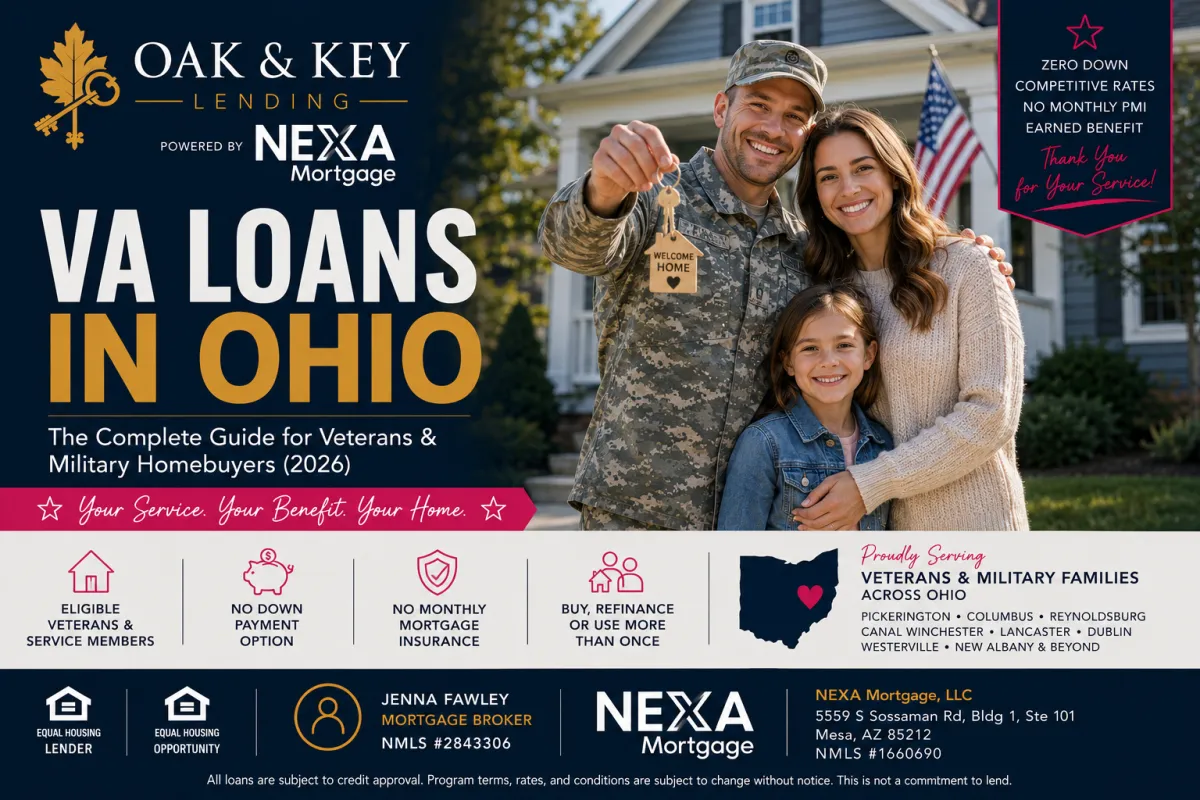
VA Loans Ohio: Guide for Veterans & Military 2026
VA Loans Ohio, Veteran Home Loans, Military Homebuyer Ohio
VA Loans in Ohio: The Complete Guide for Veterans & Military Homebuyers (2026)
VA loans are one of the most powerful homeownership tools available to eligible veterans, active-duty service members, and certain surviving spouses in Ohio. Yet many military families either don’t realize they qualify or don’t fully understand how VA mortgage benefits can help them buy a home with competitive terms and potentially zero down payment. This guide explains how VA home loans in Ohio work, what to expect in 2026, and how a local Ohio mortgage broker like Oak & Key Lending in Pickerington can help you compare options across Columbus, Central Ohio, and communities throughout the state.
What Is a VA Loan?
A VA loan is a mortgage program backed by the U.S. Department of Veterans Affairs (VA). The VA does not lend money directly in most cases. Instead, private lenders—banks, credit unions, and mortgage companies—originate VA mortgages, and the VA guarantees a portion of the loan for eligible borrowers. Because of this government guarantee, lenders can offer favorable terms, including:
No or low down payment for many qualified buyers
No monthly private mortgage insurance (PMI)
Competitive interest rates compared with many conventional options
VA home loans in Ohio are specifically designed to help eligible military borrowers achieve and sustain primary-residence homeownership, not to finance vacation homes or traditional investment properties. Whether you’re looking for a VA mortgage in Columbus, a starter home in Pickerington, or a property near Wright-Patterson Air Force Base, the core program rules are the same across the country, including Ohio (va.gov).
Who Is Eligible for a VA Loan?
VA home loan eligibility is based primarily on your military service history and VA rules, not your state of residence. In general, you may qualify if you are:
Veteran with sufficient active-duty service and an eligible discharge status
Active-duty service member meeting minimum service-day requirements (for example, 90 consecutive days during wartime or 181 days during peacetime in many cases)
National Guard or Reserve member with typically at least six years of service, or certain qualifying active-duty periods
Certain surviving spouses of veterans who died in service or from a service-connected disability
Exact VA home loan eligibility requirements can vary based on when and how you served, so it’s important to confirm details through the VA or a knowledgeable VA lender in Ohio (veteransunited.com). Oak & Key Lending can help you review your service history, request documentation, and determine whether you meet current VA loan requirements in Ohio.
What Is a Certificate of Eligibility (COE)?
Your Certificate of Eligibility (COE) is an official VA document that tells a lender you meet the basic VA home loan eligibility requirements. The COE confirms:
Your qualifying military service or surviving spouse status
Your level of VA entitlement (the amount of benefit the VA will guarantee)
Whether you may be exempt from the VA funding fee
Lenders must have a valid COE before they can close a VA mortgage. However, it’s important to understand that a COE does not automatically guarantee approval. You still must meet the lender’s credit, income, and property guidelines. A local VA lender in Ohio, such as Oak & Key Lending, can usually request your COE electronically, saving you time and paperwork.
Do VA Loans Really Require No Down Payment?
One of the biggest reasons VA loans in Ohio are so attractive is the potential for a zero down home loan. With sufficient entitlement and lender approval, many eligible borrowers can purchase a primary residence with no down payment required, up to the lender’s maximum and any applicable entitlement limits. This is a major advantage over most conventional and FHA mortgages, especially for first-time or younger military homebuyers who may not have large savings.
However, “zero down” does not mean “zero dollars needed.” You may still need cash for:
Earnest money deposit when you make an offer
Home inspection(s)
Certain closing costs and prepaid items (property taxes, homeowners insurance, interest)
Moving expenses and initial home maintenance or repairs
A knowledgeable Ohio mortgage broker can help you estimate your total cash needed and structure your offer so that seller-paid costs and lender credits, when available, help keep your out-of-pocket expenses manageable.
VA Loans and Mortgage Insurance (PMI vs. VA vs. FHA)
Another powerful VA loan benefit is that VA mortgages do not require monthly private mortgage insurance (PMI), even when you put 0% down. Compare this with:
Conventional loans: Typically require PMI if your down payment is less than 20%. PMI increases your monthly payment and may last for years.
FHA loans: Require both an upfront mortgage insurance premium and ongoing monthly mortgage insurance, often for the life of the loan unless you refinance.
Because VA loans eliminate monthly PMI, many Ohio military homebuyers enjoy lower monthly payments compared with similar conventional or FHA options, even when the interest rate is similar. Over time, that difference can add up to thousands of dollars in savings.

Comparing VA, FHA, and conventional payments often reveals VA’s long-term savings potential.
What Is the VA Funding Fee?
Instead of monthly mortgage insurance, most VA borrowers pay a VA funding fee. This is a one-time cost the VA charges to help keep the program sustainable for future veterans. The fee amount depends on your:
Type of VA loan (purchase, construction, refinance)
Whether it’s your first use or a subsequent use of VA benefits
Down payment amount, if any
As of 2026, for most purchase and construction loans (va.gov; news.va.gov):
First use: 2.15% of the loan amount with less than 5% down; 1.5% with 5% or more down; 1.25% with 10% or more down.
Subsequent use: 3.3% with less than 5% down; 1.5% with 5% or more down; 1.25% with 10% or more down.
Most borrowers choose to finance the funding fee into the mortgage instead of paying it in cash at closing, which spreads the cost over the life of the loan. A local VA mortgage broker in Ohio can help you compare scenarios and see how different down payment and funding-fee options affect your monthly payment and long-term costs.
Who Is Exempt From the VA Funding Fee?
Certain borrowers are exempt from paying the VA funding fee, including many veterans with qualifying service-connected disabilities, some Purple Heart recipients, and certain surviving spouses. Because rules can evolve and individual circumstances vary, your exemption status should always be confirmed through your COE and the VA’s current guidance. Since 2021, more than half of VA borrowers have been exempt from the fee (news.va.gov).
VA Loan Credit Requirements in Ohio
Another common misconception is that VA loans have a single, strict minimum credit score. In reality, the VA does not set one universal minimum score. Instead, each lender establishes its own guidelines. Many VA lenders in Ohio look for scores around the 620 range, but some may be more flexible, especially when other strengths are present in your file (veteransunited.com).
When evaluating a VA mortgage in Ohio, lenders consider:
Overall credit score and recent credit trends
Payment history, especially on housing and major debts
Recent derogatory items (late payments, collections, bankruptcies, foreclosures)
Length and stability of credit history
Imperfect credit does not automatically disqualify you from a VA home loan in Ohio. In many cases, a skilled loan officer can help you address credit challenges, document explanations, or develop a short-term improvement plan before you buy.
VA Debt-to-Income Ratio and Residual Income
Understanding Debt-to-Income Ratio (DTI)
Your debt-to-income ratio (DTI) compares your total monthly debt obligations to your gross monthly income. For VA loans, this generally includes your proposed mortgage payment (principal, interest, taxes, insurance, and HOA dues, if any) plus items such as auto loans, student loans, credit cards, and other recurring obligations. While VA guidelines often reference a 41% DTI benchmark, approvals are not based on DTI alone. Strong compensating factors—such as excellent credit, solid savings, or significant residual income—can support higher DTIs for some borrowers.
VA Residual Income: A Key Difference
One feature that makes VA underwriting different from many other loan types is its focus on residual income. Residual income is the amount of money you have left each month after paying your major obligations—mortgage, taxes, insurance, and other debts. The VA uses regional and household-size guidelines to help ensure borrowers have enough cash flow to cover everyday living expenses like food, transportation, and utilities.
Because Ohio is in the Midwest, VA residual income benchmarks for Ohio borrowers are based on the appropriate regional tables. This focus on residual income is one reason VA loans historically have had low default rates, even when offering zero-down financing. A good Ohio VA lender will review both your DTI and residual income to craft a payment that fits your budget.
What Properties Can You Buy With a VA Loan in Ohio?
VA loans are flexible when it comes to property types, as long as the home meets VA property requirements and will be your primary residence. Eligible property types can include:
Single-family homes in communities across Ohio, from Pickerington and Columbus to Lancaster and Grove City
VA-approved condos and townhomes, subject to VA project approval and lender guidelines
Certain manufactured homes, if they meet VA and lender standards and are properly affixed to a permanent foundation
2–4 unit properties (duplex, triplex, fourplex) when you occupy one unit as your primary residence
Not every property will qualify. Condition, safety, and legal use all matter, so working with both a VA-experienced real estate agent and a VA-savvy mortgage professional is essential.
VA Loans for Multi-Unit Properties in Ohio
Like FHA, VA loans may allow an eligible borrower to purchase a qualifying 2–4 unit property, as long as the borrower occupies one of the units as their primary residence. This can be a powerful strategy for a military homebuyer in Ohio who wants to live in one unit and rent out the others to help offset the mortgage payment. In a future guide on Investment Property Loans in Ohio, Oak & Key Lending will explore how VA, conventional, DSCR, and other options fit into multi-unit and investment strategies.
Can You Buy an Investment Property With a VA Loan?
VA purchase financing generally requires you to occupy the property as your primary residence. That means VA loans are not designed as traditional investment-property mortgages for non-owner-occupied homes. However, owner-occupied multi-unit properties and some house-hacking strategies can create investment-like opportunities while still honoring VA’s occupancy rules.
For dedicated investment properties in Ohio, borrowers usually look to conventional investment loans, DSCR loans in Ohio, or other Non-QM loans that Oak & Key Lending offers. Those options can complement your VA benefits rather than replace them, especially as your real estate portfolio grows.
VA Occupancy and Property Requirements
VA Occupancy Requirements
VA purchase loans are intended for your primary residence. Generally, you must certify your intent to occupy the home within a reasonable time after closing (or have a spouse/eligible dependent occupy in certain situations). VA loans are not designed for traditional second homes or vacation properties, although individual scenarios can be nuanced. A conversation with an experienced VA lender in Ohio can clarify how the rules apply to your situation.
VA Property Requirements and Appraisal
VA uses Minimum Property Requirements (MPRs) to help ensure homes financed with VA loans are:
Safe (no major safety hazards)
Structurally sound (no severe structural issues)
Sanitary, with functioning utilities and adequate access
A VA appraisal serves two purposes: confirming the property’s value for the lender and checking that it meets MPRs. However, a VA appraisal is not the same as a full home inspection. Buyers in Ohio should still strongly consider hiring an independent home inspector to evaluate the property’s condition in more detail and identify future maintenance needs.
VA Loan Limits and Entitlement in Ohio (2026)
There is a lot of outdated information online about VA loan limits. Today, the key concept is entitlement, not a hard loan cap. VA entitlement is the amount the VA will guarantee on your behalf. If you have full entitlement and no other active VA loans, you may be able to borrow above traditional loan-limit numbers, subject to lender approval and your qualifications (en.wikipedia.org).
For borrowers with partial or remaining entitlement—for example, if you still have an active VA loan or have defaulted on a previous VA mortgage—loan calculations may reference the conforming loan limit in your county. In 2026, the baseline conforming loan limit for a one-unit property in most Ohio counties is $832,750, with potential increases in designated high-cost areas (fhfa.gov; benefits.va.gov).
The bottom line: with full entitlement, many Ohio veterans are not limited by traditional loan caps in the way they once were. With reduced entitlement, county limits still matter. An experienced Ohio VA lender can review your COE, calculate remaining entitlement, and help you understand your options.
Can You Use a VA Loan More Than Once?
Many veterans believe VA is a one-time benefit, but that’s not the case. In many situations, you can:
Sell a VA-financed home and apply to have your entitlement fully restored for a future purchase.
Use remaining entitlement to buy another home, sometimes even while keeping an existing VA loan, depending on your circumstances.
If you previously used a VA mortgage in Ohio or another state, don’t assume you’ve “used up” your benefit. Talk with Oak & Key Lending about restoring or reusing your VA entitlement and how that affects your purchasing power today.
VA Loans vs. Conventional Loans in Ohio
FeatureVA LoanConventional LoanEligibilityVeterans, military, some surviving spousesGeneral public with qualifying credit/incomeDown paymentOften 0% down (subject to entitlement and lender)Typically 3–20% or more downMonthly PMINo PMI requiredRequired with <20% downFunding feeYes, unless exemptNo VA funding feeProperty requirementsMust meet VA MPRs, primary residenceMore flexible property types, including some investment properties
For many eligible borrowers, VA will be the most cost-effective option. In other cases—especially for large down payments or non-owner-occupied homes—a Conventional Loan in Ohio may be a better fit. Oak & Key Lending compares both options side by side so you can make an informed choice in the VA vs. conventional decision.
VA Loans vs. FHA Loans in Ohio
FeatureVA LoanFHA LoanEligibilityVeterans, military, certain spousesAny qualified borrowerMinimum down paymentOften 0% downAs low as 3.5% downMortgage insuranceNo monthly PMI; funding fee instead (if not exempt)Upfront and monthly FHA mortgage insuranceCredit flexibilityFlexible; lender-specific minimumsOften more flexible than many conventional options
When comparing VA vs. FHA, eligible veterans often find VA more affordable, especially with zero-down and no monthly PMI. However, FHA can be a strong alternative for non-eligible co-borrowers or unique credit profiles. Oak & Key’s FHA Loans in Ohio guide explores this program in more depth and helps you decide which path fits your situation best.
VA Loans for First-Time Homebuyers in Ohio
For many eligible Ohio buyers, especially younger families and first-time homeowners, VA is one of the most powerful tools available. Benefits for a first-time military homebuyer in Ohio include:
Zero-down financing in many cases, which means you can preserve savings for emergencies and moving costs.
No monthly PMI, keeping your payment more affordable than many low-down conventional or FHA options.
Competitive interest rates and flexible qualification features.
Oak & Key’s First-Time Home Buyer Guide to Ohio pairs perfectly with this VA overview, walking you through budgeting, credit, and the full purchase process from an Ohio-specific perspective.
VA Closing Costs and Seller-Paid Costs in Ohio
Common VA Closing Costs
Even with a zero-down VA loan, you’ll encounter closing costs in Ohio, such as:
VA appraisal fee
Title search, title insurance, and related title company charges
Recording fees and government transfer charges (where applicable)
Prepaid property taxes and homeowners insurance premiums
VA has specific rules about which fees the borrower can and cannot pay, and how they must be structured. A local Ohio mortgage broker familiar with VA guidelines can help you understand these details and avoid surprises at the closing table.
Can Sellers Pay Closing Costs on a VA Loan?
Yes, in many cases, sellers can contribute to your closing costs on a VA loan, within VA guidelines and local market norms. Seller contributions may cover:
Some or all allowable closing costs
Prepaid taxes and insurance
Certain seller concessions, such as paying off specific debts, within VA limits
Your real estate agent and loan officer will help structure your offer to remain competitive in markets like Columbus, Dublin, and Westerville while still seeking help with closing costs when appropriate. In a balanced or buyer-friendly market, seller contributions can significantly reduce your cash-to-close.
VA Loans in Columbus, Central Ohio, and Near Wright-Patterson AFB
Columbus & Central Ohio VA Mortgage Markets
As a locally focused Ohio mortgage broker based in Pickerington, Oak & Key Lending understands the nuances of Columbus VA loans and surrounding communities. Military and veteran homebuyers across Central Ohio—Pickerington, Reynoldsburg, Canal Winchester, Lancaster, Grove City, Westerville, Dublin, New Albany, Gahanna, and beyond—face different affordability factors, including:
Local property tax rates by city and school district
Homeowners insurance costs, which can vary by location and property type
HOA dues in certain neighborhoods and condo communities
A payment that works comfortably in one suburb may feel tight in another, even with the same purchase price. Oak & Key helps you compare neighborhoods and build a budget that accounts for these local differences, not just the base mortgage payment.
VA Loans Near Wright-Patterson Air Force Base
For service members and civilian employees near Wright-Patterson Air Force Base, VA loans are a natural fit. Communities like Dayton, Beavercreek, Fairborn, Huber Heights, and nearby areas offer a wide range of housing options for VA buyers. Whether you’re PCSing to the base or planning to stay in the region after separation or retirement, a VA loan can help you secure a primary residence close to work while preserving flexibility for future moves or rental strategies.
VA Loan Pre-Approval and the Homebuying Process in Ohio
VA Loan Pre-Approval Steps
Getting pre-approved is the best first step for any VA borrower. A typical pre-approval with Oak & Key Lending includes:
Confirming potential VA eligibility and requesting your COE.
Reviewing your income, employment, and recent work history.
Analyzing your credit, debts, and residual income.
Estimating a comfortable monthly payment and establishing a purchase budget.
For a deeper dive into the pre-approval process, Oak & Key’s Mortgage Pre-Approval Guide explains what to expect, what documents to gather, and how to avoid common pitfalls along the way.
The VA Homebuying Process: Step by Step
Pre-approval: Establish your budget and strengthen your offer in competitive markets like Columbus and Dublin.
Find a real estate agent: Preferably one experienced with VA offers and VA property requirements.
Home search: Tour homes, review disclosures, and consider both price and long-term costs like taxes and utilities.
Submit an offer: Structure price, earnest money, and seller concessions with your agent and loan officer’s input.
Purchase contract and full application: Once under contract, complete your full VA loan application and provide documentation.
VA appraisal and inspections: The lender orders the VA appraisal; you schedule any desired inspections.
Processing and underwriting: The lender verifies your information, reviews the appraisal, and clears conditions.
Clear to close: Once final approval is issued, you receive a closing disclosure and schedule your signing.
Closing: You sign your final loan documents, pay any remaining funds due, and receive your keys.
Common VA Loan Myths (and the Truth)
“You can only use a VA loan once.” False. Many borrowers use VA multiple times by restoring or reusing entitlement.
“VA loans take forever to close.” Not necessarily. With a prepared borrower and organized team, VA timelines can be similar to conventional.
“Sellers don’t accept VA offers.” Some may misunderstand VA, but strong pre-approval and clear communication can make VA offers highly competitive.
“VA loans are only for active-duty military.” False. Many veterans, Guard and Reserve members, and certain surviving spouses qualify.
“You need perfect credit.” False. VA is often more forgiving than many conventional options, especially with strong residual income or other compensating factors.
“Zero down means zero closing costs.” False. You may still need funds for closing costs, inspections, and prepaid items, though seller credits can help.
“VA loans are always the best option for veterans.” Not always. Some veterans may benefit more from conventional, FHA, or specialized products—another reason to work with a broker who compares all options, not just VA.
Mistakes VA Buyers Should Avoid
Opening new credit cards or loans during the process (especially auto loans).
Financing furniture or making large purchases before closing.
Running up balances on existing credit cards, which can hurt scores and DTI.
Changing jobs or income structure without discussing it with your lender first.
Making large, undocumented deposits into your bank accounts.
Co-signing for someone else’s loan while you’re trying to qualify for your own mortgage.
VA-specific mistake: Assuming you’re not eligible—or that you’ve “used up” your benefit—without actually checking with a VA lender.
Frequently Asked Questions About VA Loans in Ohio
Who qualifies for a VA loan in Ohio?
Eligibility is based on VA rules and your service history, not your state. Veterans, active-duty service members, many Guard and Reserve members, and certain surviving spouses may qualify if they meet VA’s service requirements and obtain a COE.
Can I get a VA loan with no down payment?
Yes, many eligible borrowers can purchase with zero down, subject to entitlement, loan size, and lender guidelines. You’ll still need funds for closing costs and other expenses unless covered by credits or seller contributions.
Do VA loans have PMI?
No. VA loans do not require monthly private mortgage insurance. Instead, most borrowers pay a one-time VA funding fee unless exempt.
What is the VA funding fee?
It’s a one-time cost paid to the VA, usually financed into the loan, that helps fund the program. The percentage varies by loan type, down payment, and whether it’s your first or subsequent VA use.
Who is exempt from the VA funding fee?
Many veterans with service-connected disabilities, certain Purple Heart recipients, and some surviving spouses may be exempt. Your COE and VA documentation will confirm your status.
What credit score do I need for a VA loan in Ohio?
The VA doesn’t set a universal minimum score, but many lenders look for around 620. Some may approve lower scores with strong compensating factors. A broker like Oak & Key can shop multiple VA lenders on your behalf.
Can I use a VA loan more than once?
Yes. VA is not a one-time benefit. You can often restore entitlement after selling a VA-financed home or use remaining entitlement in certain scenarios.
Can I have two VA loans at the same time?
In some situations, yes—especially when you have remaining entitlement and meet occupancy and qualification rules. This is common when relocating but keeping a previous home as a rental. The details are complex, so speak with a VA expert.
Can I buy a duplex or multi-unit property with a VA loan?
Yes, you may buy 2–4 unit properties if you live in one of the units as your primary residence and the property meets VA and lender requirements.
Can I buy an investment property with a VA loan?
Not in the traditional sense. VA loans are for primary residences, though owner-occupied multi-unit purchases can create rental opportunities. For pure investments, consider conventional, DSCR, or Non-QM loans.
Can I buy a condo with a VA loan?
Yes, if the condominium project is VA-approved or can be approved. Your lender can check the project’s status and help navigate any approval steps.
Can sellers pay closing costs on a VA loan?
Yes, within VA and market limits. Seller-paid costs and concessions can significantly reduce your cash-to-close, especially when combined with lender credits.
How long does a VA loan take to close?
Timelines vary, but many VA loans close in a similar timeframe to conventional loans when documentation is complete and the appraisal is ordered promptly.
Does the VA require a home inspection?
VA requires an appraisal, not a full inspection. However, buyers are strongly encouraged to obtain an independent home inspection for their own protection.
Is VA better than conventional for veterans?
Often, but not always. VA’s zero-down and no-PMI features are powerful, yet some veterans may benefit from conventional loans—especially with large down payments, jumbo purchases, or investment properties. A side-by-side comparison is essential.
Can a surviving spouse qualify for a VA loan?
In many cases, yes—particularly if the veteran died in service or from a service-connected disability. Eligibility is confirmed through the VA and a COE for surviving spouses.
Why Work With Oak & Key Lending for VA Loans in Ohio?
Your VA benefit is valuable, but navigating the details can feel overwhelming. Oak & Key Lending positions itself as your guide, not just another lender. As a locally focused Ohio mortgage broker based in Pickerington and serving Columbus, Central Ohio, and borrowers across the state, Oak & Key offers:
Personalized mortgage guidance tailored to your service history, goals, and budget.
Side-by-side comparisons of VA vs. conventional vs. FHA and specialized products like DSCR and Non-QM loans.
Access to multiple lending partners, so you’re not limited to one bank’s guidelines or pricing.
Clear communication from pre-approval through closing, with an emphasis on education and transparency.
Your Next Step: Put Your VA Home Loan Benefit to Work
You’ve earned your VA home loan benefit. The key is understanding how to use it wisely. Whether you’re buying your first home in Columbus, upgrading in Pickerington or Dublin, or planning a move near Wright-Patterson AFB, Oak & Key Lending can help you:
Confirm your VA loan eligibility and obtain or review your COE.
Estimate your purchasing power and ideal payment range.
Compare VA vs. conventional vs. FHA and other options tailored to your goals.
Begin a VA mortgage pre-approval so you can shop with confidence.
From there, explore related resources like Conventional Loans in Ohio, FHA Loans in Ohio, DSCR Loans in Ohio, Non-QM Loans in Ohio, and the First-Time Home Buyer Guide to Ohio to build a complete picture of your options.
