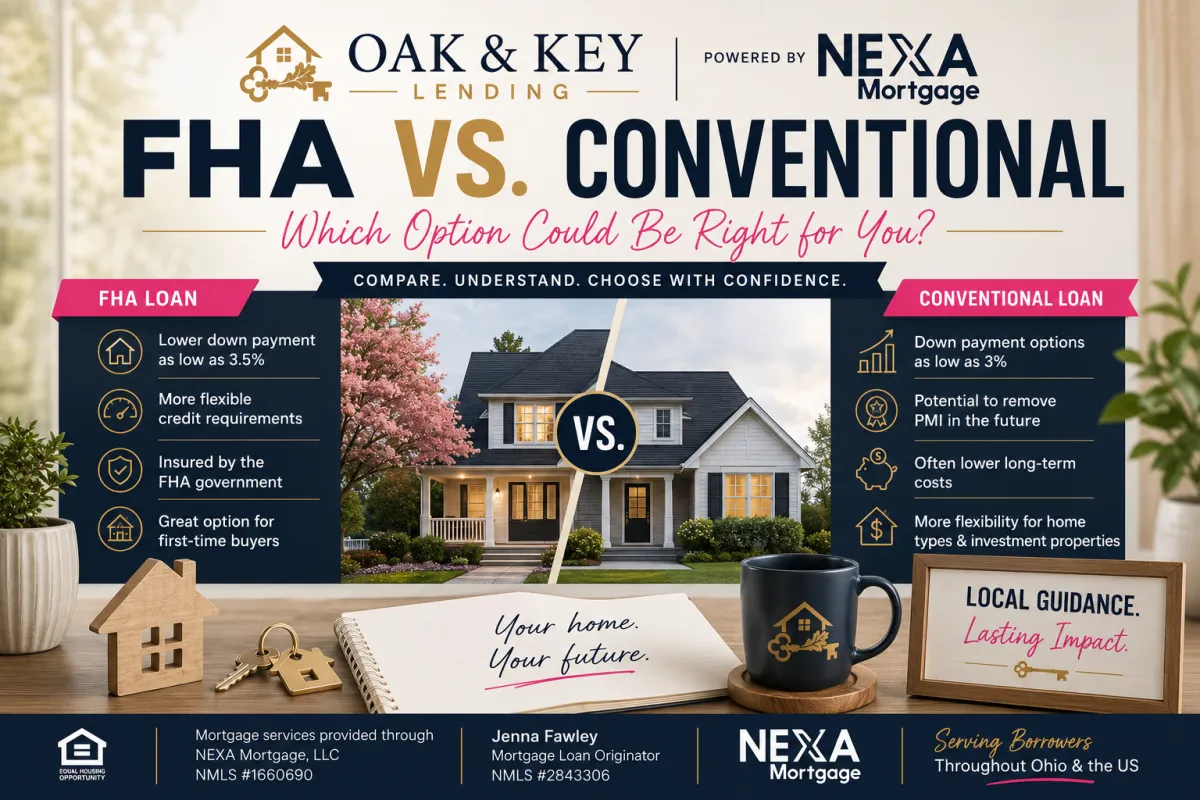
FHA vs. Conventional Loans: Which Is Better for Ohio Homebuyers?
FHA vs. Conventional Loans: Which Is Better for Ohio Homebuyers?
When you begin exploring mortgage options, two choices are likely to come up early in the conversation: FHA and conventional financing.
Both can help qualified buyers purchase a home with much less than 20% down. Both are available through mortgage lenders. And neither one is automatically the best choice for every homebuyer.
The right option depends on your credit profile, down payment, monthly budget, property, and longer-term plans.
Here is what Ohio homebuyers should understand before choosing between an FHA and conventional loan.
What Is an FHA Loan?
An FHA loan is a mortgage made by an approved lender and insured by the Federal Housing Administration, which is part of the U.S. Department of Housing and Urban Development.
Because FHA provides mortgage insurance to the lender, the program can offer more flexible qualification standards than many conventional loans. Qualified borrowers may be able to purchase an eligible primary residence with as little as 3.5% down.
FHA financing can be especially helpful for buyers who:
Have limited funds for a down payment
Need more flexibility around credit
Have a higher debt-to-income ratio
Plan to use gift funds or approved assistance
Are purchasing an eligible one-to-four-unit primary residence
FHA is not limited to first-time homebuyers. Repeat buyers may also qualify when they meet the program’s occupancy and eligibility requirements.
What Is a Conventional Loan?
A conventional loan is a mortgage that is not insured or guaranteed through a specific federal government program such as FHA, VA, or USDA.
Many conventional mortgages are conforming loans designed to meet Fannie Mae or Freddie Mac requirements. Conventional financing can offer competitive pricing and greater flexibility for borrowers with stronger credit profiles.
Some qualified homebuyers can purchase a primary residence with as little as 3% down through eligible conventional programs. However, the exact requirements depend on the program, borrower, property, and transaction.
Conventional financing may be worth considering when you:
Have good or excellent credit
Want a low-down-payment option
Want the possibility of eventually removing mortgage insurance
Are purchasing a primary residence, second home, or investment property
Want to compare several different loan structures
Not every conventional borrower needs 20% down. That figure is primarily associated with avoiding private mortgage insurance—not meeting a universal minimum requirement.
FHA vs. Conventional Loans at a Glance
FHA loan
Down payments may be as low as 3.5%
Generally offers more credit flexibility
Requires FHA mortgage insurance
Primarily designed for eligible owner-occupied properties
Property must meet FHA eligibility and appraisal requirements
Loan limits apply and vary by location
Conventional loan
Certain programs may allow as little as 3% down
Qualification may be more sensitive to credit
Private mortgage insurance may apply below 20% down
PMI may eventually be eligible for cancellation
Options may be available for primary residences, second homes, and investment properties
Conforming loan limits apply
These are broad differences. Your actual terms, costs, and eligibility will depend on your complete application.
Which Loan Has the Lower Down Payment?
The minimum difference can be small.
A qualified conventional borrower may have access to a 3% down-payment option, while FHA financing may allow a qualified borrower to put down 3.5%.
On a $300,000 home, that would look like:
3% conventional down payment: $9,000
3.5% FHA down payment: $10,500
5% down payment: $15,000
20% down payment: $60,000
But the minimum down payment does not tell you which loan is more affordable.
You should also compare:
Interest rate
Annual percentage rate
Mortgage insurance
Closing costs
Monthly payment
Funds remaining after closing
Long-term cost of the loan
A slightly larger down payment could sometimes improve conventional loan pricing. In another scenario, FHA’s qualification flexibility may make it the more realistic or affordable path.
Which Loan Is Better for Buyers With Lower Credit Scores?
FHA financing generally allows greater credit flexibility than most conventional loans. The Consumer Financial Protection Bureau notes that FHA loans can be easier to obtain for borrowers with lower credit scores, while conventional loans may cost less but be more difficult to qualify for.
That does not mean everyone with a lower score will qualify for FHA financing.
Individual mortgage lenders may apply requirements beyond FHA’s baseline guidelines. Approval also depends on factors such as:
Payment history
Monthly debts
Income stability
Available assets
Recent credit activity
Bankruptcies or foreclosures
Property eligibility
Overall underwriting findings
It also does not mean that a buyer with good credit should automatically choose conventional financing. The full loan comparison still matters.
How Does Mortgage Insurance Work?
Mortgage insurance is one of the most important differences between FHA and conventional loans.
FHA mortgage insurance
FHA loans generally include both an upfront mortgage insurance premium and an annual mortgage insurance premium that is commonly collected through the monthly mortgage payment. FHA mortgage insurance is required regardless of credit score.
The upfront premium can often be financed into the loan rather than paid entirely in cash at closing. Financing it increases the total loan balance.
How long the annual FHA mortgage insurance remains depends partly on the original loan-to-value ratio and loan term. For many borrowers putting down less than 10%, the annual premium can remain for the mortgage term. With an initial loan-to-value ratio of 90% or less, it may apply for 11 years under current FHA rules.
A borrower may later evaluate refinancing into a conventional loan, but refinancing is not guaranteed to be beneficial or available. It depends on future credit, equity, property value, rates, closing costs, and qualification requirements.
Conventional private mortgage insurance
Private mortgage insurance, commonly called PMI, may be required when a conventional borrower purchases a home with less than 20% down. PMI protects the lender—not the borrower—if the mortgage goes into default.
Unlike FHA mortgage insurance, conventional PMI pricing may be affected by factors such as:
Credit profile
Down-payment amount
Loan term
Property type
Occupancy
Mortgage insurance coverage
Eligible borrowers can generally request PMI cancellation when the mortgage balance is scheduled to reach 80% of the home’s original value, provided applicable requirements are met. Automatic termination may occur when the balance is scheduled to reach 78% and the borrower is current, subject to the law’s conditions and exceptions.
This potential for cancellation is one reason conventional financing may offer a long-term advantage for some borrowers.
Which Loan Costs Less?
There is no universal answer.
The CFPB explains that conventional loans typically cost less than FHA loans but can be harder to qualify for. It also notes that FHA can sometimes be the lower-cost option for borrowers with lower credit scores or smaller down payments, while conventional financing may be less expensive for borrowers with stronger credit and a medium-sized down payment.
The comparison can change based on:
Credit score
Down payment
Interest rate
Mortgage insurance
Loan amount
Discount points
Closing costs
Length of time you plan to own the home
Whether conventional PMI can later be removed
A lower interest rate does not automatically mean a less expensive loan. The mortgage insurance, fees, and total cash required should also be considered.
Once you have a property and are formally applying, compare the Loan Estimates for each option. A Loan Estimate shows important costs, payment information, and loan terms in a standardized format.
What Are the Property Requirements?
Both FHA and conventional lenders need to confirm that the home offers sufficient value and is eligible for the selected loan.
An FHA appraisal also evaluates whether the property meets FHA eligibility and minimum property requirements. FHA standards are intended to address issues affecting the home’s safety, soundness, and security.
This does not mean an FHA-financed home must be newly renovated or cosmetically perfect.
Peeling paint, exposed wiring, significant roof problems, broken systems, structural concerns, or other health and safety issues may require additional review or repairs. What matters depends on the specific property and the appraiser’s findings.
Conventional financing also has property-condition requirements. A severely damaged or uninhabitable home may not qualify for standard conventional financing either.
For properties requiring substantial work, renovation financing or another specialty loan may be more appropriate than a traditional FHA or conventional purchase loan.
Can You Buy a Multifamily Home With FHA Financing?
FHA financing may be available for eligible one-to-four-unit properties when the borrower intends to occupy one of the units as a primary residence. HUD identifies one-to-four-unit structures as eligible under its basic FHA home mortgage program.
This can create an opportunity to:
Live in one unit
Rent the remaining units
Use eligible rental income in qualification
Begin building a real estate portfolio
However, two-to-four-unit properties can have additional underwriting, appraisal, reserve, and property requirements.
A conventional loan may also be available for an owner-occupied multifamily property, depending on the borrower and program.
Is FHA Only for First-Time Homebuyers?
No.
FHA loans are often associated with first-time buyers because of their lower down-payment requirement and credit flexibility. However, FHA financing is not restricted only to people purchasing their first home.
A repeat buyer may qualify as long as the borrower, property, occupancy, and transaction meet FHA requirements.
Similarly, not every conventional low-down-payment program is limited to first-time buyers. Program eligibility varies, which is why it is helpful to compare options rather than relying on assumptions.
Can You Use Down-Payment Assistance?
Potentially.
Both FHA and eligible conventional loans may be paired with certain approved down-payment or closing-cost assistance programs. The assistance may come from a government agency, housing finance agency, employer, nonprofit organization, or another permitted source.
Fannie Mae permits qualifying borrowers to use certain third-party assistance, grants, gifts, and Community Seconds with eligible loans. FHA may also allow qualifying gifts and approved assistance.
Every assistance program has its own rules. Some assistance is structured as a grant, while other programs involve a forgivable loan, deferred loan, or repayable second mortgage.
Before choosing assistance, compare:
Interest rate
Total closing costs
Monthly payment
Repayment terms
Forgiveness period
Occupancy requirement
Resale or refinance restrictions
How long you plan to own the home
Assistance can make purchasing more achievable, but the complete financing package still needs to make sense.
When Might FHA Be the Better Option?
FHA may be worth considering when:
Your credit profile makes conventional financing more expensive
You need additional debt-to-income flexibility
You have a limited down payment
You are using eligible gift funds or assistance
You are purchasing an owner-occupied multifamily property
FHA provides the stronger overall approval or payment scenario
The CFPB notes that FHA can often be the least expensive option for borrowers with smaller down payments or lower credit scores.
When Might Conventional Be the Better Option?
Conventional financing may be worth considering when:
You have strong credit
You can qualify for favorable conventional pricing
You want mortgage insurance that may eventually be removed
You are purchasing a second home or investment property
You want more flexibility around property type
The total conventional payment and closing costs are lower
You expect to keep the mortgage for a longer period
Conventional does not always mean a large down payment. Certain qualified borrowers may have access to 3% down-payment options.
Do Not Choose Based on the Down Payment Alone
The loan requiring the least money upfront is not automatically the best loan.
Consider how each option affects:
Your cash at closing
Monthly mortgage payment
Mortgage insurance
Emergency savings
Interest rate
Closing costs
Ability to make a competitive offer
Future refinancing possibilities
Long-term cost of homeownership
For example, using more of your savings for a down payment might lower your payment but leave you with less money for repairs or emergencies.
Putting less down might allow you to preserve cash, but it could increase the monthly payment and mortgage insurance.
The right balance is personal.
Questions to Ask When Comparing FHA and Conventional Loans
Before choosing, ask your mortgage professional:
Which programs do I currently qualify for?
What would my down payment be under each option?
What are the estimated closing costs?
How much mortgage insurance would I pay?
How long would the mortgage insurance remain?
What would my total monthly payment be?
Does the property meet the program requirements?
Are assistance programs available?
How much cash would I have left after closing?
Which option appears more affordable over the time I expect to own the home?
A side-by-side comparison is much more useful than a general statement that one program is always better.
Frequently Asked Questions
Is an FHA loan better than a conventional loan?
Not automatically. FHA may provide greater credit and qualification flexibility, while conventional financing may offer lower long-term costs for certain borrowers. The better option depends on the complete scenario.
Can I get a conventional loan with 3% down?
Certain conventional programs allow eligible borrowers to purchase a primary residence with as little as 3% down. First-time buyer, income, occupancy, property, and other requirements may apply depending on the program.
Is FHA mortgage insurance permanent?
It depends on the original loan-to-value ratio and loan term. For many FHA borrowers putting less than 10% down, annual mortgage insurance remains for the mortgage term. For certain loans beginning at 90% loan-to-value or lower, it may apply for 11 years.
Can conventional PMI be removed?
Eligible borrowers may request cancellation when the principal balance is scheduled to reach 80% of the home’s original value, subject to applicable requirements. PMI may automatically terminate at 78% when the borrower is current, with certain exceptions.
Does FHA require a perfect home?
No. Cosmetic imperfections do not automatically disqualify a property. However, the home must meet FHA eligibility and property standards, and certain safety, structural, or operational issues may need to be addressed.
Can I switch from FHA to conventional later?
You may be able to refinance into a conventional mortgage later, but approval and savings are not guaranteed. Future rates, equity, credit, income, property value, mortgage insurance, and closing costs must all be considered.
Compare Your Ohio Mortgage Options
You do not need to decide between FHA and conventional financing on your own.
Oak & Key Lending helps Ohio homebuyers compare available mortgage programs, estimated payments, down-payment requirements, mortgage insurance, and closing costs.
The goal is not to push one particular loan. It is to help you understand which financing path fits your qualifications, property, budget, and longer-term plans.
This content is provided for general educational and informational purposes only and is not a commitment to lend or a guarantee of qualification. Loan programs, mortgage insurance, terms, costs, and eligibility requirements may change and vary by borrower, property, and transaction. All loans are subject to applicable credit, income, asset, identity, occupancy, property, and underwriting verification.
