Mortgage Pre-Qualification vs. Pre-Approval: What Ohio Homebuyers Should Know
Mortgage Pre-Qualification vs. Pre-Approval: What Ohio Homebuyers Should Know
You are ready to start looking at homes, and someone asks whether you are pre-qualified or pre-approved.
Are they the same thing? Is one better? Do you need either one before contacting a real estate agent?
The answer is not as simple as it may seem. Mortgage companies do not always use these terms in exactly the same way. The Consumer Financial Protection Bureau explains that the process behind the letter matters more than the label printed at the top.
Still, understanding the general difference can help you know what to expect and choose the right time to begin.
What Is Mortgage Pre-Qualification?
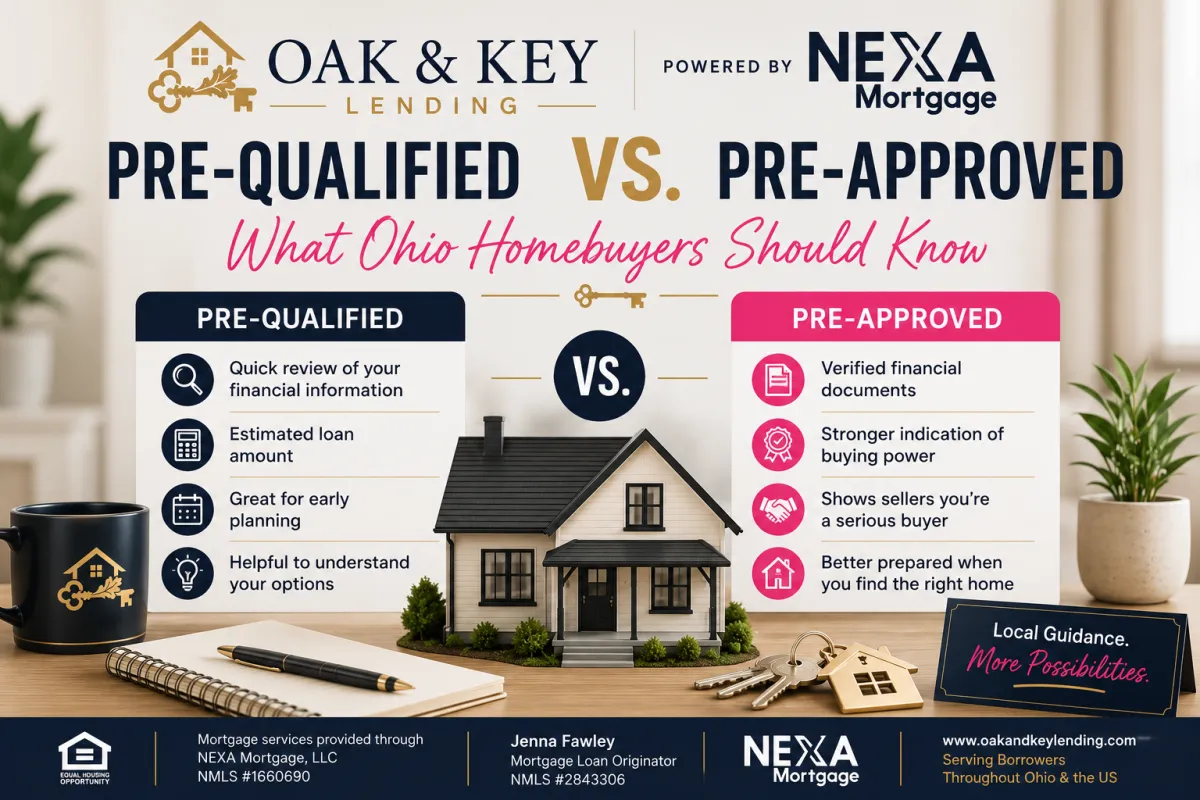
Mortgage pre-qualification is generally an early evaluation of your potential home-financing options.
You may provide information about your:
Income and employment
Monthly debts
Credit history
Available savings and assets
Estimated down payment
Preferred property type
Homebuying timeline
Depending on the mortgage professional and the process being used, this information may be reviewed with a soft credit check, a hard credit inquiry, or no credit inquiry at the earliest stage.
A pre-qualification can give you a preliminary idea of:
Whether you may qualify for mortgage financing
Which loan programs may be worth exploring
An estimated purchase-price range
A possible monthly payment range
How much money you may need for a down payment and closing costs
Whether there are financial areas to work on before buying
This can be especially helpful when you are still researching, planning several months ahead, or trying to understand whether buying a home is realistic.
What Is Mortgage Pre-Approval?
A mortgage pre-approval usually involves a more detailed review of your financial information.
You may be asked to provide documents supporting your income, employment, assets, debts, and other parts of your application. Common documents can include pay stubs, W-2s, tax returns, bank statements, identification, and documentation of additional income sources. The exact requirements depend on your employment, financial profile, and loan program.
After reviewing the available information, the mortgage professional may issue a letter showing that you are generally qualified to borrow up to a stated amount, subject to conditions.
A pre-approval letter can help you:
Set a more informed homebuying budget
Focus your search on an appropriate price range
Show a real estate agent that you have taken steps toward financing
Demonstrate to a seller that you are a serious buyer
Identify potential documentation or qualification issues earlier
Move more efficiently when you find a property
Freddie Mac notes that a pre-approval letter can provide a maximum borrowing amount and help demonstrate that a buyer is serious. However, it is not a final loan guarantee.
The Terminology Can Vary
It is easy to assume that every pre-qualification is basic and every pre-approval includes a complete financial review.
That is not always true.
One company may call its process a pre-qualification even though it reviews credit and financial documents. Another may call a less detailed evaluation a pre-approval.
The CFPB advises borrowers not to focus too heavily on which term is used. Instead, ask what information was actually reviewed and what conditions still need to be satisfied.
Useful questions include:
Was my credit reviewed?
Was the credit check soft or hard?
Were my income and assets documented?
Were my monthly debts reviewed?
Was an automated underwriting system used?
Is the amount based on verified information or estimates?
What conditions still need to be completed?
When does the letter need to be updated?
Those answers tell you more than the label alone.
Is Pre-Qualification Enough to Start Looking at Homes?
It may be enough during the early research stage, but it depends on how soon you plan to make an offer.
A preliminary pre-qualification can be useful when you are:
Considering whether to buy
Establishing a savings goal
Comparing possible loan programs
Trying to estimate an affordable payment
Planning six months or more in advance
Working on credit, debt, or income documentation
Once you are actively touring homes and preparing to submit offers, a more complete review may provide greater confidence.
Real estate agents and sellers may also prefer a current letter showing that your financial information has been reviewed. In a competitive situation, the strength and reliability of your financing can matter alongside the offer price and other terms.
Does Pre-Qualification or Pre-Approval Affect Your Credit?
It depends on the process.
Some mortgage evaluations use a soft credit inquiry, which generally does not affect your credit score. Others require a hard credit inquiry, which may have a small, temporary effect.
Fannie Mae also offers lenders an early-assessment process that can use a soft credit pull during pre-qualification, although a new credit report may still be required when the borrower proceeds to a full mortgage application.
Before authorizing a credit check, ask:
Will this be a soft or hard inquiry?
Which credit-reporting agencies will be accessed?
Will another credit report be required later?
How long will the current report remain usable?
Do not avoid getting properly prepared because you are worried about a credit inquiry, but do understand what type of review is being completed.
What Documents Might You Need?
Your mortgage professional will provide a specific list based on your situation, but it can help to begin gathering documents early.
Salaried or Hourly Employees
You may need:
Recent pay stubs
W-2 forms
Bank or investment statements
Identification
Employment history
Information about current debts and housing expenses
Self-Employed Borrowers
You may need:
Personal and business tax returns
Year-to-date profit-and-loss statements
Business bank statements
Personal bank statements
Business ownership documentation
Additional information about the nature and history of the business
Not every self-employed borrower will use traditional tax-return documentation. Bank statement, 1099, profit-and-loss, asset-based, and other specialty mortgage programs may be available depending on the borrower and property.
Real Estate Investors
You may need:
Current mortgage statements
Homeowners insurance information
Lease agreements
Property tax information
Documentation of rental income
Statements for investment or business accounts
Information about the property being purchased
The documents required for an investor loan can vary considerably depending on whether you are using conventional financing, a DSCR loan, bridge financing, or another business-purpose program.
How Much Should You Get Pre-Approved For?
A mortgage pre-approval may show the maximum amount you appear qualified to borrow. That does not mean you should automatically spend that amount.
Your comfortable budget should also account for:
Property taxes
Homeowners insurance
Mortgage insurance
Homeowners association dues
Utilities
Maintenance and repairs
Moving expenses
Emergency savings
Other financial priorities
Freddie Mac advises buyers to borrow an amount that remains comfortable within their budget rather than automatically stretching to the maximum qualification amount.
Tell your mortgage professional the monthly payment you would feel comfortable carrying. That may be more useful than beginning with the highest purchase price available.
Is a Pre-Approval a Guarantee?
No.
A pre-qualification or pre-approval is not a final commitment to lend. It is generally based on the information available at that time and remains subject to applicable conditions.
Final loan approval may depend on:
Updated income, employment, asset, and credit verification
An acceptable purchase contract
Property eligibility
A satisfactory appraisal
Title review
Homeowners insurance
Underwriting approval
Loan-program requirements
No significant changes to your financial circumstances
The property itself matters because a borrower can appear financially qualified while a particular home does not meet the requirements of the chosen loan program. The CFPB describes both pre-qualification and pre-approval letters as useful indicators rather than guaranteed loan offers.
Avoid Major Financial Changes Before Closing
Once you have been pre-qualified or pre-approved, try to maintain a stable financial profile through closing.
Before making a significant change, talk with your mortgage professional. That includes:
Changing jobs
Reducing work hours
Becoming self-employed
Opening or closing credit accounts
Financing a vehicle
Co-signing for another borrower
Making a large credit-card purchase
Moving money between accounts
Depositing large amounts of undocumented cash
Spending money reserved for closing
A change does not always prevent you from qualifying, but it may require additional documentation or affect the loan amount, program, or approval.
When Should You Get Started?
You do not need to wait until you have found a home.
Consider beginning the conversation when you are:
Planning to buy within the next year
Unsure how much money you need
Comparing different loan options
Concerned about your credit
Self-employed or earning nontraditional income
Purchasing an investment property
Ready to begin touring homes
Preparing to make an offer
Starting early gives you time to identify issues, gather documents, explore assistance programs, and create a realistic plan.
A preliminary conversation does not obligate you to apply for a mortgage or purchase a home.
What Happens After You Find a Home?
Once your offer is accepted, the complete mortgage process begins.
Your loan will generally move through steps such as:
Confirming the property and purchase terms
Updating your financial information
Selecting the loan program
Reviewing disclosures
Ordering the appraisal and other required services
Completing underwriting
Satisfying approval conditions
Preparing for closing
Your pre-qualification or pre-approval gives you a head start, but it is not the end of the process.
Frequently Asked Questions
Can I get pre-qualified before choosing a real estate agent?
Yes. Getting pre-qualified early can help you establish a realistic budget before touring properties. It can also give your real estate agent a clearer idea of the price range and loan requirements involved.
Do I need a specific property address?
Not necessarily. A preliminary mortgage evaluation can generally be completed before you identify a property. Final approval will depend on the specific home, appraisal, title, insurance, and program requirements.
How long does a pre-approval last?
The timing varies by mortgage company, credit-report expiration, documentation requirements, and changes in your financial profile. Ask when your letter and supporting documents will need to be updated.
Can I be pre-approved if I am self-employed?
Potentially. Self-employed borrowers may qualify through traditional income documentation or specialty programs such as bank statement, 1099, profit-and-loss, or asset-based loans. The appropriate option depends on your income, business history, credit, assets, and property.
Can I get pre-approved for an investment property?
Yes. Investors may explore conventional investment property financing, DSCR loans, multifamily financing, bridge loans, fix-and-flip loans, and other business-purpose programs.
Does a pre-approval lock my mortgage rate?
Not usually. A pre-approval evaluates your potential qualification, while a rate lock is a separate step subject to lender policies, market conditions, a specific property, and loan details.
Does getting pre-approved commit me to one mortgage company?
A pre-approval generally does not require you to close your eventual mortgage with that company. The CFPB notes that buyers can continue comparing available loan offers before choosing their financing.
Start With a Clearer Picture
You do not need to know the perfect loan program or have every detail figured out before reaching out.
Oak & Key Lending helps Ohio homebuyers explore their potential mortgage options, understand the information needed, and prepare for the next step.
Whether you are purchasing your first home, moving into your next one, or simply trying to understand what may be possible, an early conversation can give you a more useful plan.
Oak & Key Lending is a brand operated through NEXA Mortgage, LLC. Mortgage services provided through NEXA Mortgage, LLC | NMLS #1660690. Jenna Fawley, Mortgage Loan Originator | NMLS #2843306.
This material is provided for general educational and informational purposes only. A pre-qualification or pre-approval is not a commitment to lend or a guarantee of final loan approval. Loan programs, terms, availability, and eligibility requirements vary. All loans are subject to applicable credit, income, asset, identity, occupancy, property, and underwriting verification.
